
Why Xops ?
At the front of machine-to-machine (M2M) and connected vehicle technologies state-of-art, XOPS is a supervisory control platform for scheduling, tracking and optimizing mobile operations of airside ground support equipment (GSE) in airport.
XOPS customers are aircraft ground handling service companies or airport authorities with a high level of requirement in productivity and safety. Aircraft ground handling services address baggages, passengers, fuel, catering and cargo transportation between the time the aircraft arrives at a terminal gate and the time it departs on its next flight. Speed and accuracy are important in order to minimize the time during which the aircraft must remain parked at the gate and also to improve the level of airside safety. XOPS is made to reach such speed and accuracy.


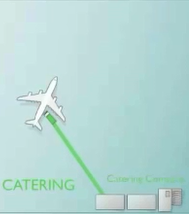
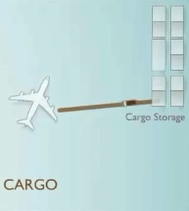
Schedule and Optimization
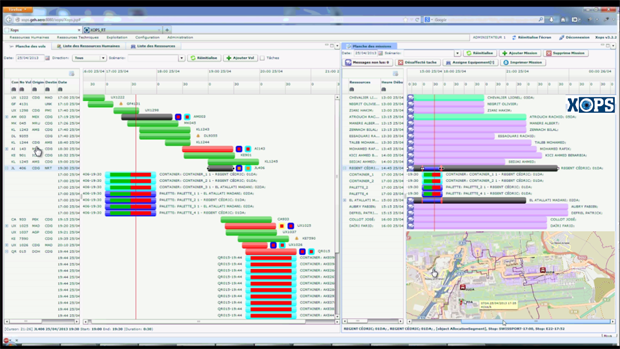
Optimized planification and managment of all mobile equipment : Intelligent scheduling and allocation XOPS software monitors and optimizes work plans by acquiring and processing in real-time flights information, human-equipment resources availability, source-destination points, and corrresponding travel times.
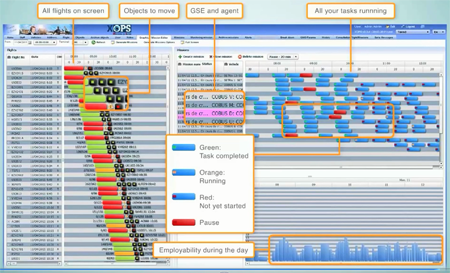
XOPS user can monitor all the tasks for a specific flight : mobile ground equipments, drivers, status (completed, running, not yet started) and resources employability.
The difference with others airport fleet management systems is that XOPS provides much more control over movements and operations of the GSE fleet.
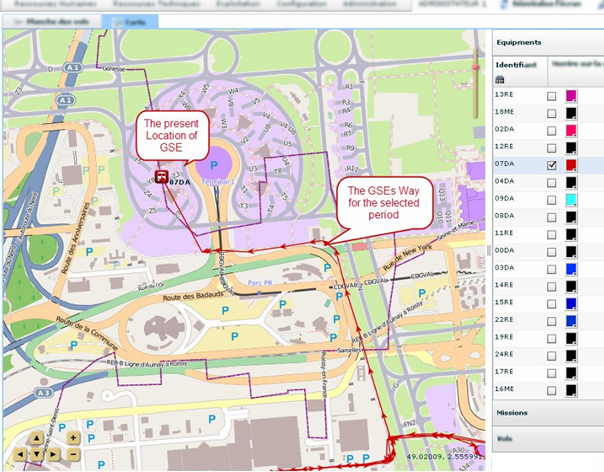
Detailed mobile asset position monotoring via GPS : XOPS pilots automatically the movement of GSE and drivers on events occuring in real time such as redirection to new terminal gate or delay of aircrafts.
XOPS allows to redraw on a map the itinerary path of a selected equipment in a certain time period.
Tracking of Content (cargo containers, baggages)
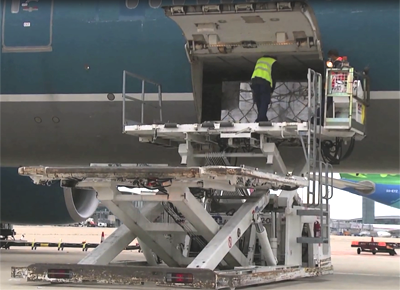
As cargo containers and baggages are being loaded & unloaded to & from aircraft, their labels are scaned.
Their identification data are then transmitted to XOPS server application that time stamps all loading & unloading events.
Task segment can be partially green (container has been picked up from aircraft) and partially red (container not yet delivered to destination terminal). Task segment length is the duration.
Automatic Reassignment
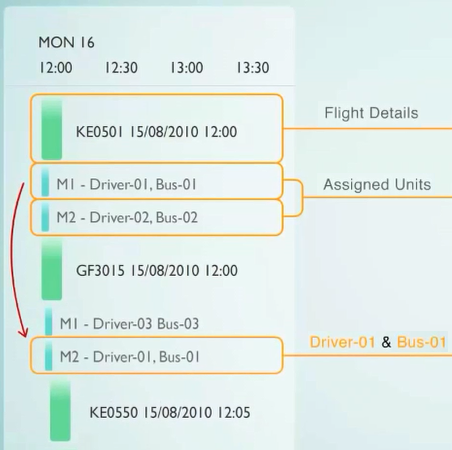
XOPS displays all flight details of each flight in the flight planning status panel as well as all {driver; mobile equipment} units that are assigned to a flight.
If a {"Driver-01"; "Bus-01"} unit has finished a mission, both Driver-01 and Bus-01 will be automatically reassigned to a next mission.
Mobile driver application
XOPS embedded application for drivers is available on Windows Mobile and Androïd operating systems.
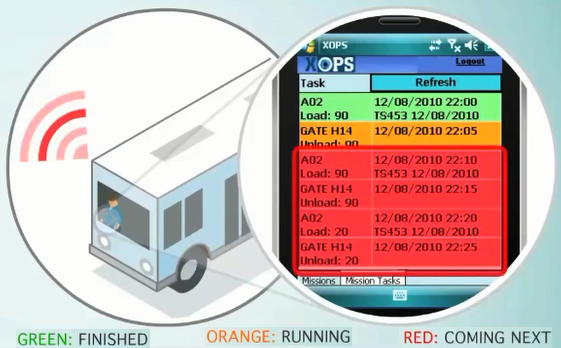
All scheduled task for a {driver; mobile equipment} unit are categorized in different colors and displayed on the driver's mobile device.
Driver has to confirm the status change of a task (e.g. a bus driver has to confirm all passengers have left the bus) before proceeding to the next location.


Why Medianate ?
At the front of software-defined-video (SDV) processing technologies state-of-art, Medianate is a large scale triple video processing platform for :
- Transcoding to bring video to any device and network anytime at once,
- Analysis for big video data searching and video surveillance purposes,
- Just-in-time editing for new content production such as video ads insertion just before the delivery.
Medianate target customers are over-the-top (OTT) video-on-demand (VoD) service providers, video content delivery networks (CDN) to optimize their delivery of video content to end users on Internet, telecommunication operators and video surveillance operators.
 |
 |
 |
Transcoding |
Analysis |
Just-in-time Editing |
Video transcoding seemingly countless times into different formats to distribute large inventory of files over various networks to a wide assortment of devices. |
Analysis of huge volume of video content tailored to the needs of video surveillance, intelligent transportation services and VoD services searching functionalities. |
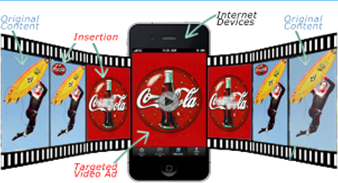
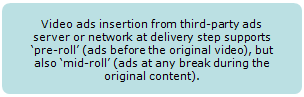
Dynamic insertion of graphics, text, metadata and third party video content (pre-roll, mid-roll and post-roll) in the original content at the delivery step. |
Benefits
- Expertise of the twelve-years-old company in development and roll out of multimedia systems for customers such as software publishers, telecommunications operators, content producers and institutions.
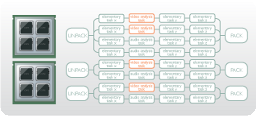
- Combined editing and protection with transcoding: cutting, stitching, extraction and recombination of elementary streams are coupled with pure transcoding, and also with DRM packaging and optional watermarking for content traceability.
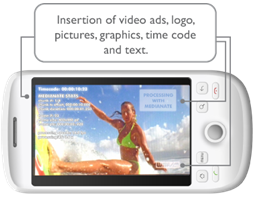
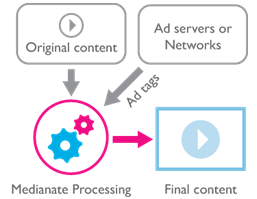
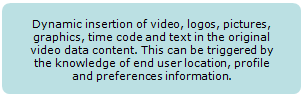
- Personalization of additional content insertion:
 |
 |
 |
 |
- Plug-in architecture for video analysis: Third-party developers of image analysis algorithms can leverage their work by integrating it in MEDIANATE as plugin thanks to the MEDIANATE data flow architecture. They take immediately benefits of MEDIANATE for processing huge volume of video content.
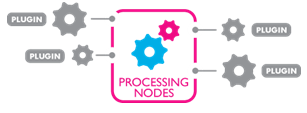 Dedicated API and SDK allow to easily build plugins that can request MEDIANATE nodes to extract thumbnails and analysis output results for individual frames or entire video streams. All output results are stored and managed for future search purpose. All plugins are dynamically taken into account by all distributed MEDIANATE processing nodes with no need of reinitialization.
- High volume data processing:
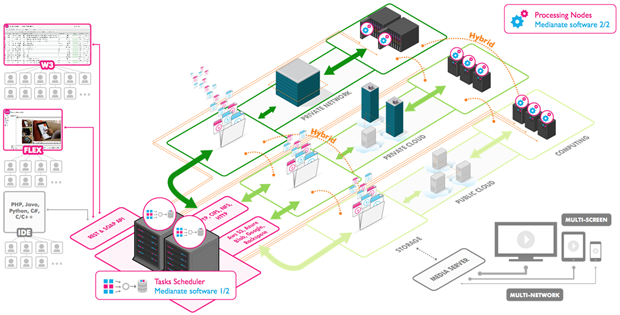
- Distribution of processing tasks among multiple cooperating computing nodes.
- Handling multi core and multi CPU architectures in every nodes.
- Centralized tasks scheduling and distributed processing.
- Watched Folders mechanism: A set of predefined folders with associated processing parameters can be set up so that all video files are automatically processed whenever they are arriving in these folders from remote locations
- Auto-scalability: Implementation of specific algorithms to massively balance and distribute processing loads in order to handle multiple computing nodes and multi CPU architectures.
- Distributed data among LAN, WAN and cloud storage infrastructures: Implementation of multiple network access stacks: FTP, HTTP, CIFS, NFS and cloud storage infrastructures for Amazon S3, Azure Blob, Rackspace Cloud Files, Google Cloud Storage and Google YouTube. Alibaba Cloud Computing OSS for China specificity is on going.
- SOAP and RESTful web services API allows the integration of Medianate with other components of existing workflow including content management (CMS) and monetization systems. External applications can send requests to create, update and manage user accounts, presets profiles and processing tasks.
- Management:
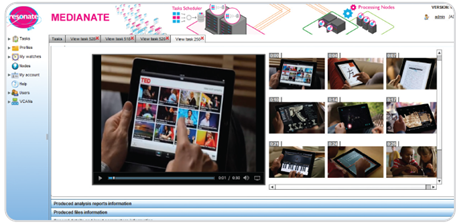
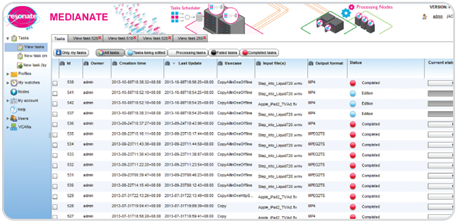
- Dashboard user interface is a web application that is fully client of the Medianate web services API. It provides views of user accounts, processing nodes, watched folders, presets profiles, tasks and input/output media files.
- History of the whole activity with performance statistic reports extraction.
- Privacy and security with user accounts and credentials with protected media home repositories.
- Medianate can be deployed in seamless transition from an inhouse solution to a private and public cloud solution:
- Inhouse or Private Cloud: deployed in single appliance, cluster of servers or private cloud infrastructure and operated by corporate IT services.
- Public cloud: wholly or partially used as software-as-a-service after deployment in public cloud infrastructure.